
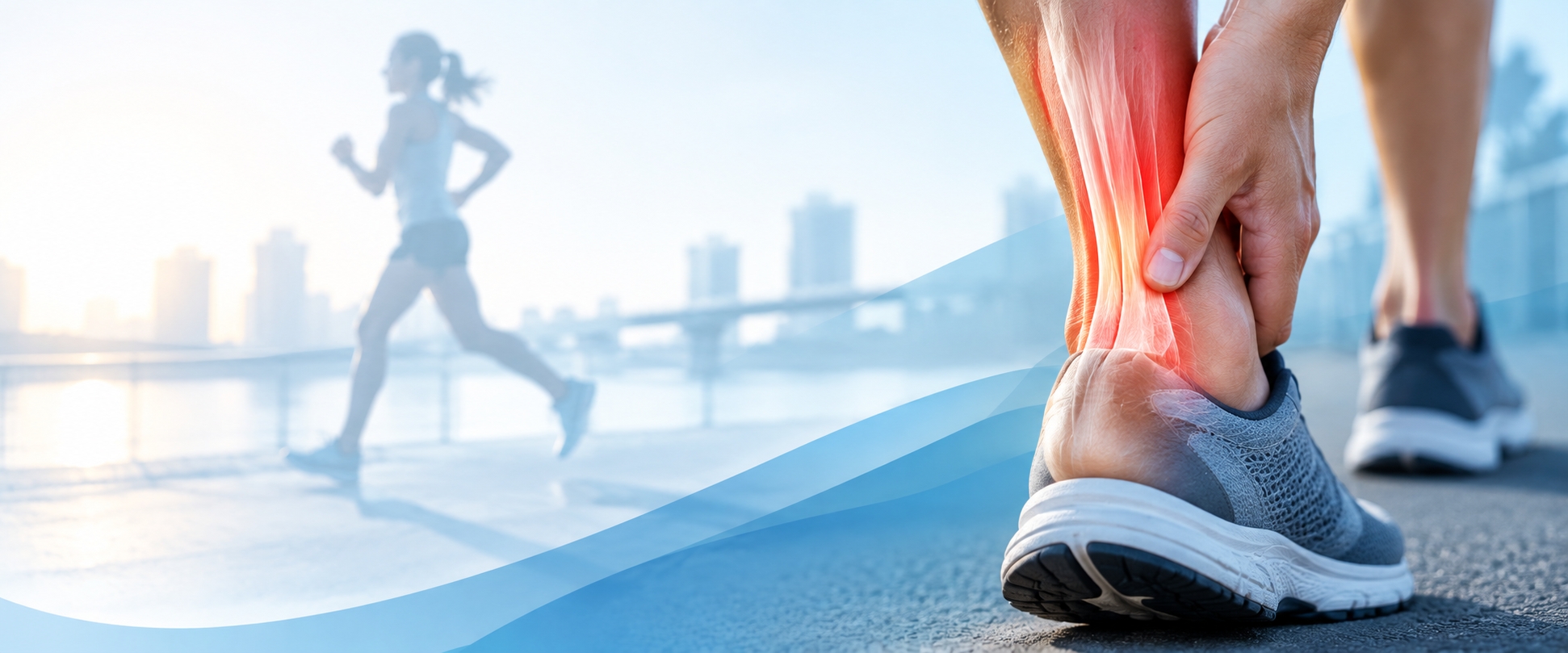
Achilles tendinopathy is a common cause of pain around the back of the ankle and lower leg. It can affect runners, athletes and people who have recently changed their activity levels, but it can also develop without a single obvious injury. At YOS Health London Bridge, physiotherapy focuses on identifying contributing factors and progressively restoring tendon and calf capacity.
What is Achilles Tendinopathy?
The Achilles tendon is a strong band of connective tissue connecting the calf muscles to the heel bone. It transfers force from the calf to the foot and is essential for walking, running, jumping and pushing off the ground.
Achilles tendinopathy describes pain and reduced tolerance to loading in the Achilles tendon. Symptoms may occur in the middle portion of the tendon, known as mid-portion Achilles tendinopathy, or closer to its attachment to the heel, known as insertional Achilles tendinopathy.
The condition is often associated with a mismatch between the load placed on the tendon and its current capacity. Sudden increases in running, hill work, sprinting, jumping or other demanding activities may therefore contribute to symptoms.
What Causes Achilles Tendinopathy?
There is rarely one single cause. Achilles tendon pain can develop when the tendon is repeatedly exposed to loads that exceed its ability to recover and adapt.
- Sudden increases in running distance, speed or frequency
- Introducing hills, sprints or jumping after reduced activity
- Changes in training surfaces or footwear
- Reduced calf strength or endurance
- Insufficient tolerance to repeated high-load activities
- Returning to sport too quickly after a break or injury
- Changes in overall training load, recovery or conditioning
Achilles tendinopathy is not necessarily caused by one particular movement, footwear choice or posture. A physiotherapy assessment considers the wider picture, including training history, activity levels, strength, movement and symptom response to loading.
Common Symptoms
Symptoms vary depending on the location and severity of the condition. Common symptoms include:
- Pain or tenderness at the back of the ankle
- Stiffness when first getting up in the morning
- Pain when starting to walk or exercise
- Symptoms that increase during or after running or jumping
- Tenderness when pressing the tendon
- Reduced calf strength or endurance
- Difficulty performing repeated heel raises
- Reduced confidence or power during push-off
Some people find that symptoms ease during activity but become more noticeable later that day or the following morning. Monitoring this response can help determine whether the current loading level is appropriate.
How is Achilles Tendinopathy Diagnosed?
A physiotherapist can usually assess Achilles tendinopathy through your symptoms, activity history and physical examination. Assessment may include the location of pain, ankle movement, calf strength, single-leg heel raise capacity, balance and tolerance to different loading activities.
Imaging is not always necessary. Ultrasound or other investigations may be considered when the diagnosis is uncertain, symptoms are unusual, recovery is not progressing as expected, or another condition needs to be investigated.
Physiotherapy Treatment for Achilles Tendinopathy
Activity Modification
Complete rest is not always necessary. Your physiotherapist can help identify activities that aggravate symptoms and modify their volume, intensity or frequency while maintaining appropriate activity.
Calf Strengthening
The calf muscles and Achilles tendon work together as a functional unit. Strengthening is therefore a central part of rehabilitation. Exercise can progress from manageable loads towards heavier and more sport-specific demands.
Progressive Tendon Loading
Tendons adapt to appropriately dosed loading. Rehabilitation may progress from controlled exercises to heavier resistance, single-leg work and eventually faster activities such as hopping, running and jumping where appropriate.
Movement and Technique Assessment
Your physiotherapist may assess running mechanics, lower-limb strength, ankle mobility, balance and the way you produce and absorb force. This can help identify modifiable factors contributing to symptoms or limiting your return to activity.
Return to Work and Sport
Returning to running or sport is best treated as a progression rather than a single milestone. The aim is to gradually expose the tendon to the speed, volume and intensity it needs to tolerate.
Exercises for Achilles Tendinopathy
The most appropriate exercises depend on your symptoms, tendon location, strength and activity goals. A rehabilitation programme may include:
Seated Calf Raises
Seated calf raises can introduce controlled resistance while targeting the calf complex. They can be progressed by gradually increasing resistance and repetitions.
Standing Calf Raises
Standing heel raises increase the demand on the calf and Achilles tendon. Start at a level that can be completed with good control and progress towards heavier resistance as tolerated.
Single-Leg Heel Raises
Single-leg heel raises challenge strength and endurance more directly. Repetition quality and capacity can be used to monitor progress.
Isometric Calf Loading
Static calf holds may be useful at certain stages of rehabilitation when dynamic loading needs to be introduced gradually.
Hopping and Plyometric Exercises
People returning to running and sport eventually need to develop the ability to produce and absorb force quickly. Hopping, skipping and jumping drills can be introduced progressively once sufficient tendon and calf capacity has been developed.
Exercise response matters: some discomfort does not automatically mean that the tendon is being damaged, but symptoms should be monitored during exercise and over the following 24 hours. Your physiotherapist can help establish appropriate loading parameters for you.
How Long Does Achilles Tendinopathy Take to Recover?
Recovery varies considerably between individuals. Achilles tendinopathy often develops gradually, and meaningful improvements in strength and load tolerance can take several weeks to months.
Factors that may influence recovery include symptom duration, tendon location, baseline strength, training demands, recovery habits, consistency with rehabilitation and how quickly activity is progressed.
Rather than relying only on a calendar, progress can be monitored through practical measures such as pain response, walking tolerance, heel-raise capacity, strength, running tolerance and sport-specific performance.
Returning to Running After Achilles Tendinopathy
Running places substantially greater repetitive demands on the Achilles than ordinary walking. A return-to-running programme should therefore build capacity progressively.
- Establish comfortable day-to-day walking and functional tolerance.
- Build calf strength and endurance.
- Introduce low-level impact work where appropriate.
- Begin controlled running with manageable volume.
- Gradually increase distance, frequency and intensity.
- Reintroduce hills, faster running and sport-specific drills later in the programme.
Returning directly to your previous mileage or speed can overload a tendon that has not yet regained sufficient capacity.
How Can Achilles Tendinopathy Be Prevented?
- Increase training volume progressively rather than making abrupt changes
- Maintain calf strength throughout the year
- Allow appropriate recovery between demanding sessions
- Avoid sudden large increases in hills, sprinting or jumping
- Build sport-specific capacity before returning to full competition
- Address persistent symptoms early rather than repeatedly training through worsening pain
When Should You See a Physiotherapist?
Consider a physiotherapy assessment if Achilles pain is persistent, repeatedly returns when you increase activity, limits running or sport, or affects normal daily activities.
An assessment can help determine the likely source of symptoms and provide an individual rehabilitation plan rather than relying on generic exercises.
Why Choose YOS Health London Bridge?
At YOS Health London Bridge, physiotherapy for Achilles and lower-limb conditions combines clinical assessment, strength testing, movement analysis and progressive rehabilitation.
The goal is not simply to reduce pain. Rehabilitation is designed to improve the tendon and calf's ability to tolerate the demands of everyday life, running, training and sport.
Your programme may include exercise therapy, load-management advice, hands-on treatment where appropriate, movement assessment and a structured return-to-sport plan.
Frequently Asked Questions
Is Achilles tendinopathy the same as Achilles tendonitis?
The terms are sometimes used interchangeably, but "tendinopathy" is commonly preferred because persistent tendon pain involves more than a simple acute inflammatory process.
Should I stop running if I have Achilles pain?
Not necessarily. Depending on your symptoms, running may sometimes be modified rather than stopped completely. A physiotherapist can help determine an appropriate activity level and progression.
Are eccentric heel drops the only exercise I need?
No. Eccentric loading can be useful, but rehabilitation may also include progressive resistance, isometric work, endurance training, hopping and sport-specific loading.
Can Achilles tendinopathy be treated without surgery?
Many cases are managed conservatively with appropriate load management and progressive rehabilitation. Surgery is not the first-line treatment for most uncomplicated cases.
Can I massage an Achilles tendon that is painful?
Hands-on treatment may be used as part of a broader rehabilitation programme, but it should not replace progressive loading and appropriate activity management.
What is the difference between mid-portion and insertional Achilles tendinopathy?
Mid-portion symptoms are usually felt a few centimetres above the heel bone, whereas insertional symptoms occur where the Achilles attaches to the heel. Exercise selection and loading strategy may differ between these presentations.